Learn about the concept behind PremiAL
and how it reduces environmental impact to help drive decarbonization.
Chapter 1
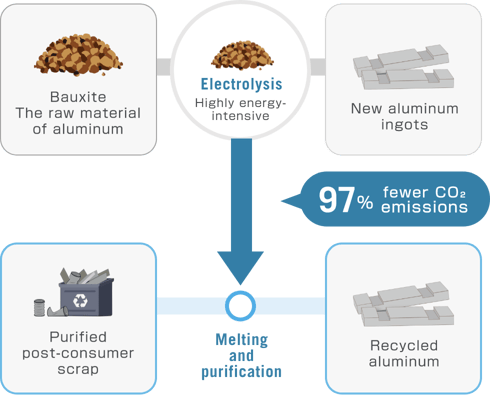
Producing aluminum from primary materials requires significant energy during smelting, resulting in high CO2 emissions. Expanding use of recycled aluminum instead of primary materials is therefore key to reducing the environmental impact associated with smelting.
Aluminum has a lower melting point than many other metals, allowing it to be melted and recycled with relatively little energy. In fact, recycling requires only about 3% of the energy it takes to produce new aluminum from mineral resources. As a result, using recycled material instead of primary resources can reduce CO2 emissions from aluminum production by 97%.
Given the growing demand for aluminum, this holds significant potential for decarbonization.
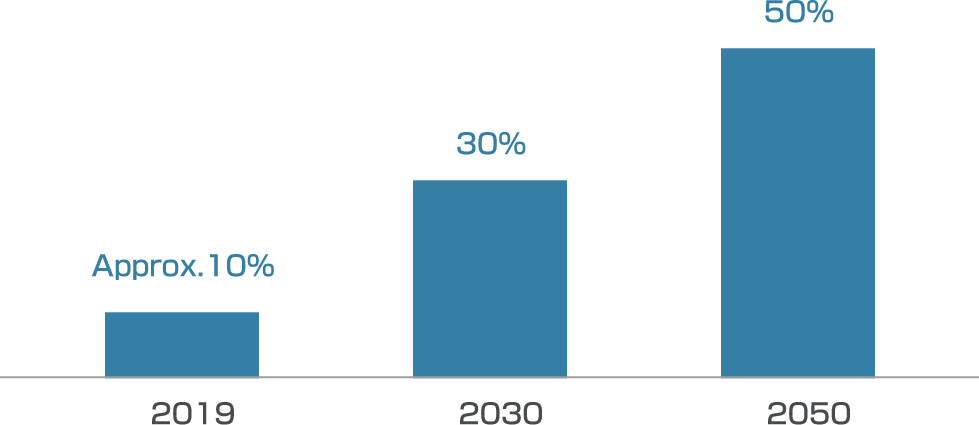
Target recycling rates for extrusions
Source: The Japan Aluminum Association’s Aluminum VISION 2050
(https://www.aluminum.or.jp/vision2050/)
Japan has established a successful recycling scheme for aluminum beverage cans, with a recycling rate of 99.8%.*2 However, recycling rates are far lower for aluminum used in other sectors, including the building materials industry.
Increasing aluminum recycling rates requires promoting the circular reuse of extrusions used in construction, vehicles and other applications. Extrusions are created through the process of extrusion: shaping metal by applying pressure. The current rate at which extrusions are recycled back into other extrusions is said to be as low as 10%.
One major reason for the lack of progress in extrusion recycling is the difficulty in isolating recyclable aluminum from scrap materials.
Sorting requires advanced technology to remove non-aluminum parts such as screws and the wide variety of dissimilar alloys often found in scrap. These challenges have slowed progress in recycling.
*1 Aluminum extrusions used in building materials
*2 Source: Japan Aluminum Can Recycling Association(https://www.alumi-can.or.jp/pages/98/)
Chapter 2
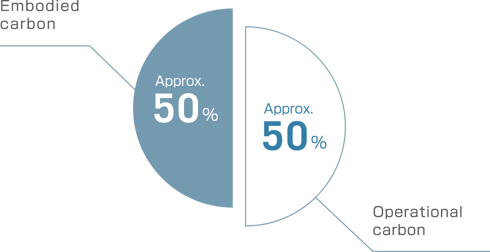
Breakdown of the whole-life carbon that accounts for 37%*1 of global CO2 emissions
*1 Source: IEA World Energy Statistics and Balances
Source: Net-zero buildings:
Where do we stand? (2021), World Business Council for Sustainable Development
The buildings construction sector accounts for approximately 37% of global CO2 emissions. About 50% of this comes from energy used during building occupancy and operation, known as operational carbon. Progress in reducing operational carbon is being made through advances such as high-performance windows and net-zero energy homes and buildings (ZEH/ZEB).
The remaining 50% consists of emissions associated with building construction—from raw material sourcing and processing to shipping, construction, renovation and disposal—collectively known as embodied carbon. Reducing embodied carbon requires visualizing CO2 emissions for each process and component, and using these figures as indicators in design and material selection.
Embodied carbon
Construction-related CO2 emissions from raw material sourcing and processing to shipping, construction, renovation and disposal

Requires visualizing CO2 emissions for each process and component, and using these figures as indicators in design and material selection
Operational carbon
CO2 emissions from energy used during building occupancy and operation

Wider adoption of high-performance windows and ZEH/ZEB expected to reduce CO2 emissions
Chapter 3
Guided by our Environmental Vision 2050, LIXIL aims to realize circular living and achieve net-zero CO2 emissions across all operations, products and services by 2050. We have also set a target to increase the use of recycled aluminum to 100% by FYE2031.
LIXIL’s aluminum products now contain an average of 80%*2 recycled materials (in FYE2025, 6063 alloys), which is one of the highest rates in the industry.
This achievement is supported by world-leading technology and expertise in aluminum recycling, built up over nearly 30 years. We have developed recycling technologies that go beyond the melting process, encompassing including casting, extrusion and surface treatment.
Securing high-quality aluminum scrap is also crucial for increasing recycled content. To do so, we are building a robust supply chain at the collection, dismantling and sorting stages, working with our business partners to deepen expertise.
*1 Recovering materials from end-of-life LIXIL products and reusing or recycling them to produce new LIXIL products
*2 Based on the definition of “recycled content” set by the Japan Sash Manufacturers Association() https://www.jsma.or.jp/)

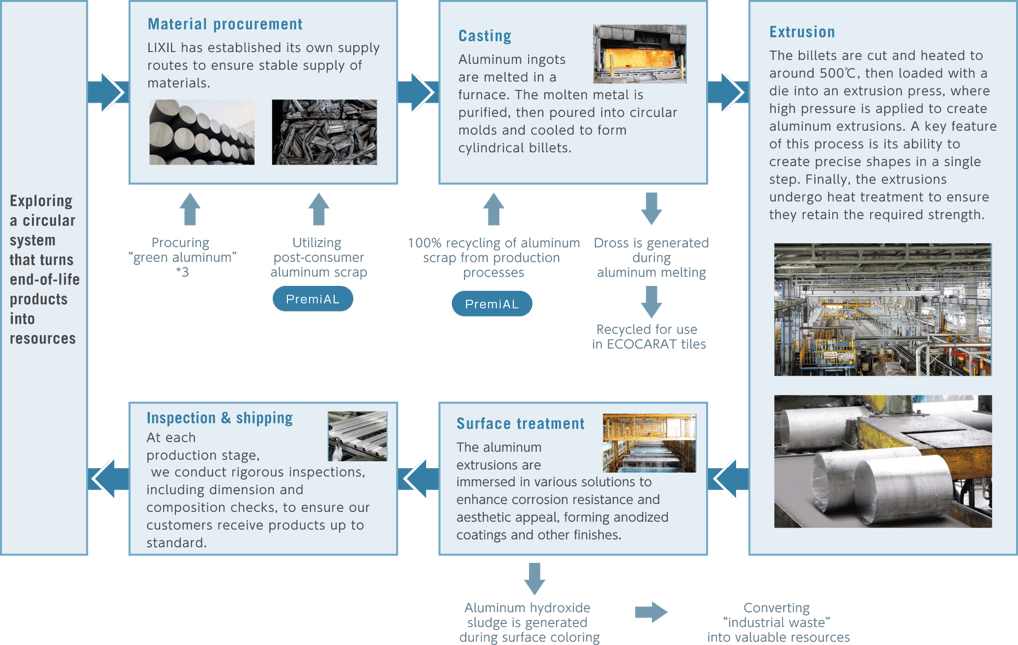
LIXIL is driving a wide range of initiatives to advance aluminum recycling.
By combining advanced recycling technology with a stable supply of post-consumer aluminum scrap obtained through strong supplier partnerships, we have succeeded in mass producing 6063 billets made from 100% recycled aluminum. We are also promoting the procurement of low-carbon "green aluminum" *3 when the use of new ingots is unavoidable.
We view waste generated in the aluminum manufacturing process as a resource, and are working to reuse or convert materials previously treated as industrial waste into something of value. This approach also addresses the challenge of managing the additional byproducts that will be generated during melting as the use of recycled aluminum increases.
We are also exploring ways to create a circular system in which aluminum recovered from deconstructed buildings is recycled and used to produce extrusions for new buildings.
Through these initiatives, we aim to create a closed-loop aluminum recycling system using LIXIL's proprietary technologies.
*3 Generally refers to aluminum materials (such as aluminum ingots and billets used in extrusion) produced using renewable energy (solar or hydroelectric power with CO2 emissions of 4 kg-CO2/kg or less).